B2B design retainers

B2B Design retainers for happier teams

Outsourced design production across whitepapers, presentations, social, animation, brand and digital, without adding headcount

problems we solve

continuity

Repeated scoping, onboarding and approvals slow momentum and reset context each time, making sustained production harder than it needs to be.

internal capacity

Senior marketers and in-house teams don't always have the bandwidth or specialist design expertise required for sustained content production.

hiring commitments

A retainer provides immediate, structured production capacity without recruitment cycles, onboarding, or long-term employment commitments.

Our team has worked with

brand support from a-z

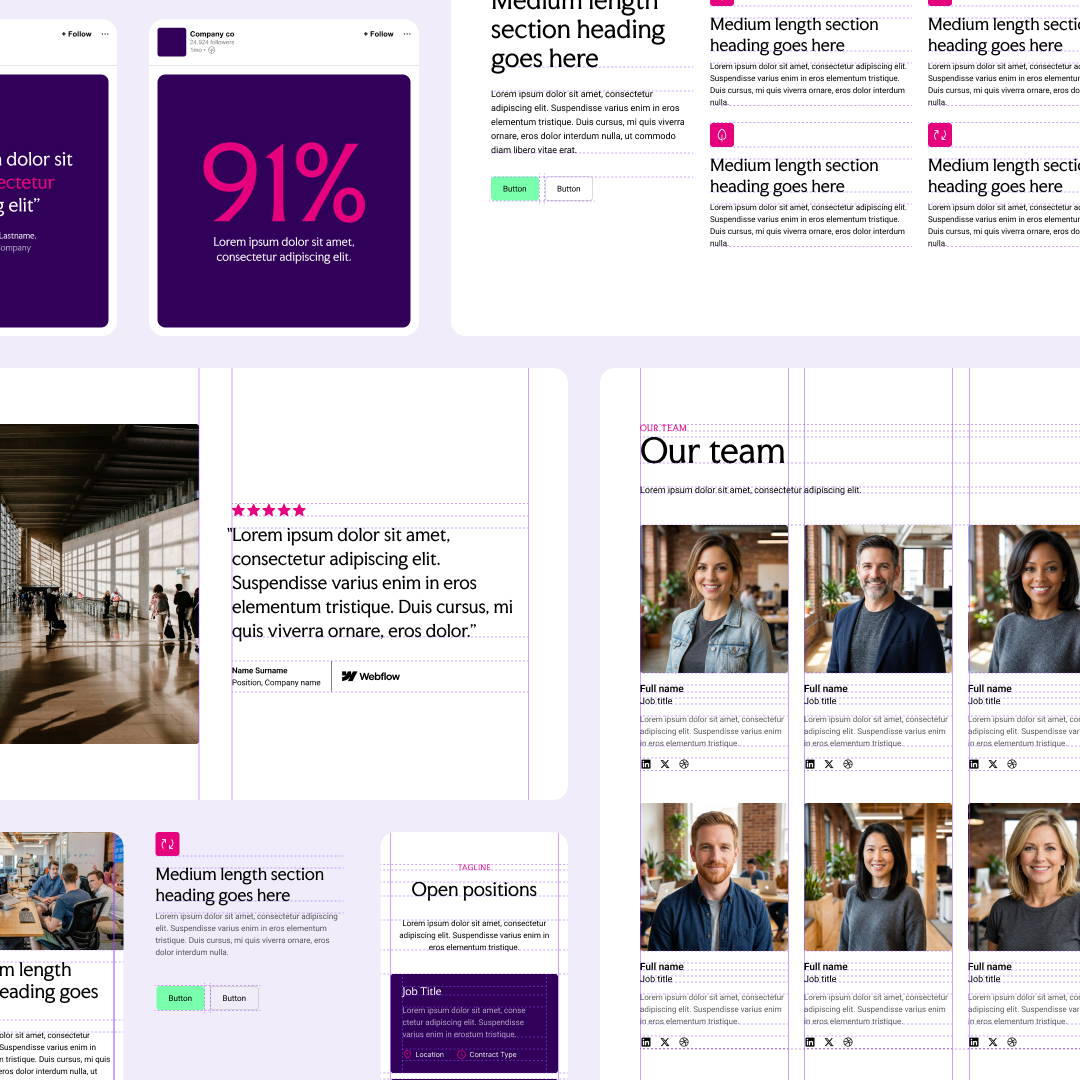
brilliant brand assets, from whitepapers to digital experience

Whitepapers

Clear, authoritative editorial design that gives complex thinking structure, credibility, and room to breathe.

Reports

Designed to support complex thinking, giving ideas the structure and confidence they need to be clearly understood.

Presentations

Powerpoint & Google Slides that help ideas land consistently across rooms, teams and screens.

Product Guides

Clear, practical guide design that supports education and conversion across web, print, and presentation.

Social ads

Campaign creative designed to drive clicks, leads, and conversions across platforms and formats.

Product explainers

2D & 3D animated video explainers that help people quickly grasp how your product works and why it’s valuable.

Data Visualisation

On-brand charts and diagrams that present complex information clearly and credibly to B2B audiences.

Illustration

Custom illustration systems designed to support content, add clarity, and scale across digital and editorial formats.

event design

Distinctive event environments and assets that carry the brand confidently into physical spaces.

Product Experience

We help B2B teams build scalable product design sytems for engaging, and consistently on-brand product experiences.

Brand definition

We help with maintaining brand codes, with support in identifying strengths and inconsistencies, and helping turn up with intention.

Motion Design

Short and long-form 2D and 3D animations that express your brand with character, and earn attention.

getting to know you

Brand Guardianship, with Peace of Mind

With defined capacity reserved each month, plus weekly briefing and check-ins, we actively help you establish and maintain brand codes, so output stays consistent and aligned for the long-term. You're free to move between formats as priorities shift, without being limited by scheduling, bandwidth, or skills gaps.
start the conversation

Book a no-strings-attached chat with us to share your project, hear our initial thoughts, and decide if we’re a team you’d enjoy working with.
OtherFolk® Journal
Brand Management

Brand Refresh vs Rebrand (aka When You Just Need to Get Your House in Order)

Not every brand problem needs a rebrand. In many cases, the strategy still holds, but the way it shows up has drifted. That is where a brand refresh comes in.

TBC Minute read

A lot of B2B teams default to “we need a rebrand” when things start to feel off. In reality however, the underlying thinking is often still sound. The audience is the same, the positioning makes sense, and the business is moving in the right direction. However, what has changed is the way the brand is being applied.

How brands drift over time

Over time, brands drift. Not in a dramatic way, but through small, everyday decisions that slowly move things off course. A slightly different layout here, a new colour there, a deck that does its own thing, a landing page that feels disconnected. None of it feels like a problem in isolation, but it adds up.

You end up with a brand that looks familiar, but no longer feels consistent. Good work still happens, but it is uneven. Some pieces land well, others feel off, and there is no clear thread holding it all together. And when that happens, the brand stops behaving like a system and starts behaving like a collection of individual outputs.

That lack of cohesion creates drag. Teams spend more time making judgement calls, reviewing work, and fixing inconsistencies than they should. It becomes harder to maintain quality, not because the team lacks capability, but because the framework they are working within is no longer clear.

That is usually the point where a refresh is needed.

A refresh is not about redefining the business. It's simply about bringing the brand back in line with what is already true

What a refresh actually does

A refresh is not about redefining the business. It's simply about bringing the brand back in line with what is already true, and making it usable again in a practical sense. It takes what exists, and tightens it, turning a loose set of ingredients into something more structured and reliable.

That means redefining how the brand actually behaves in real work; how layouts are approached, how typography and colour is applied, and how everything is used intentionally across different formats. As with any well-coded brand, this gives the team a clearer way of working, not just a set of assets.

In redefining and tightening brand rules, work becomes more consistent because there is less ambiguity. This also means production can also speed up simply, particuarly when volume increases, because fewer decisions need to be made. Output starts to build on itself, rather than varying each time something new is created.

None of this requires a new strategy. That is the key difference. If the core thinking still holds, a rebrand is unnecessary. The business does not need to redefine itself, it just needs to express itself properly.

Brand Management

When is the right time to rebrand?

Rebrands tend to happen when the business has moved on, but the brand hasn’t kept pace. If that gap is starting to affect how you show up or how you sell, it’s worth taking seriously.

TBC Minute read

Rebrands don’t usually start as a clear decision; it tends to build over time. The business has moved forward, but the brand has stayed where it was, and eventually that gap becomes hard to ignore. It’s at this point where it’s worth stepping back and asking whether the brand still reflects the business properly.

If it doesn’t, it tends to show up in a few consistent ways:

1. You can’t clearly articulate what the business is anymore

Brand management is essentially co-owned by all employees. It doesn't simply live with the marketing team, but in how everyone works with it. Brands are living and evolving things, and particularly at larger companies this often means descriptions become subjective, and language shifts where different people explain the company in different ways. This might mean sales teams are saying one thing, the marketing team another, and customers are left putting it back together in whatver way resonated with them the most.

This isn’t a copy issue; it usually means the underlying definition of what the business is, who it’s for, and why it matters simply isn't in focus. A rebrand forces clarity and resets the core thinking, so everyone is on the same page.

2. Your product or offer has outgrown the way the brand is structured

Many brands are built around a simpler version of the business. As the product expands or the offer becomes more layered, the brand starts to stretch. This becomes apparent in fragmented messaging, inconsistent naming, or different parts of the business feeling disconnected from each other. At that point, the issue is structural; a rebrand allows you to rebuild the brand around what the business actually is now, so it can scale without constant workarounds.

It rarely shows up as one big issue. It’s usually small delays, repeated conversations, and constant correction. At that point, the brand is no longer supporting the team.

3. You are blending into the category

As markets mature, they converge. Competitors start to sound and look similar, often drawing from the same references and making similar claims. If your brand sits within that, even the strongest products start to feel interchangeable, and it's harder to create separation. It's a choice of standing out or blending in. A rebrand gives you the chance to sharpen how you are positioned and express that difference clearly enough to be recognised.

4. Internal teams aren’t aligned on how the brand should show up

When the brand isn’t clearly defined, teams interpret it differently. Output varies, decisions take longer, and more time is spent debating than producing. This isn’t just a design issue. It points to a lack of shared understanding about what the brand is and how it should behave. A rebrand creates that shared foundation, making it easier to stay consistent without constant oversight.

5. The brand is starting to slow you down

This is where it becomes more obvious. Work takes longer to produce, decisions are harder to make, and more effort is required to get the same result. You notice longer ramp times in conversations, more reliance on explanation, and a heavier lift to establish credibility. It rarely shows up as one big issue. It’s usually small delays, repeated conversations, and constant correction. At that point, the brand is no longer supporting the team. A rebrand removes that friction so the business can move at the pace it needs to.

Rebrands take time and commitment, which is why they’re often delayed. But when the brand no longer reflects the reality of the business, incremental changes tend to fall short. The aim is to bring the brand back into line with what the business actually is, so it can do its job properly.

Still unsure whether you need a refresh or a full rebrand? Read more on that here.